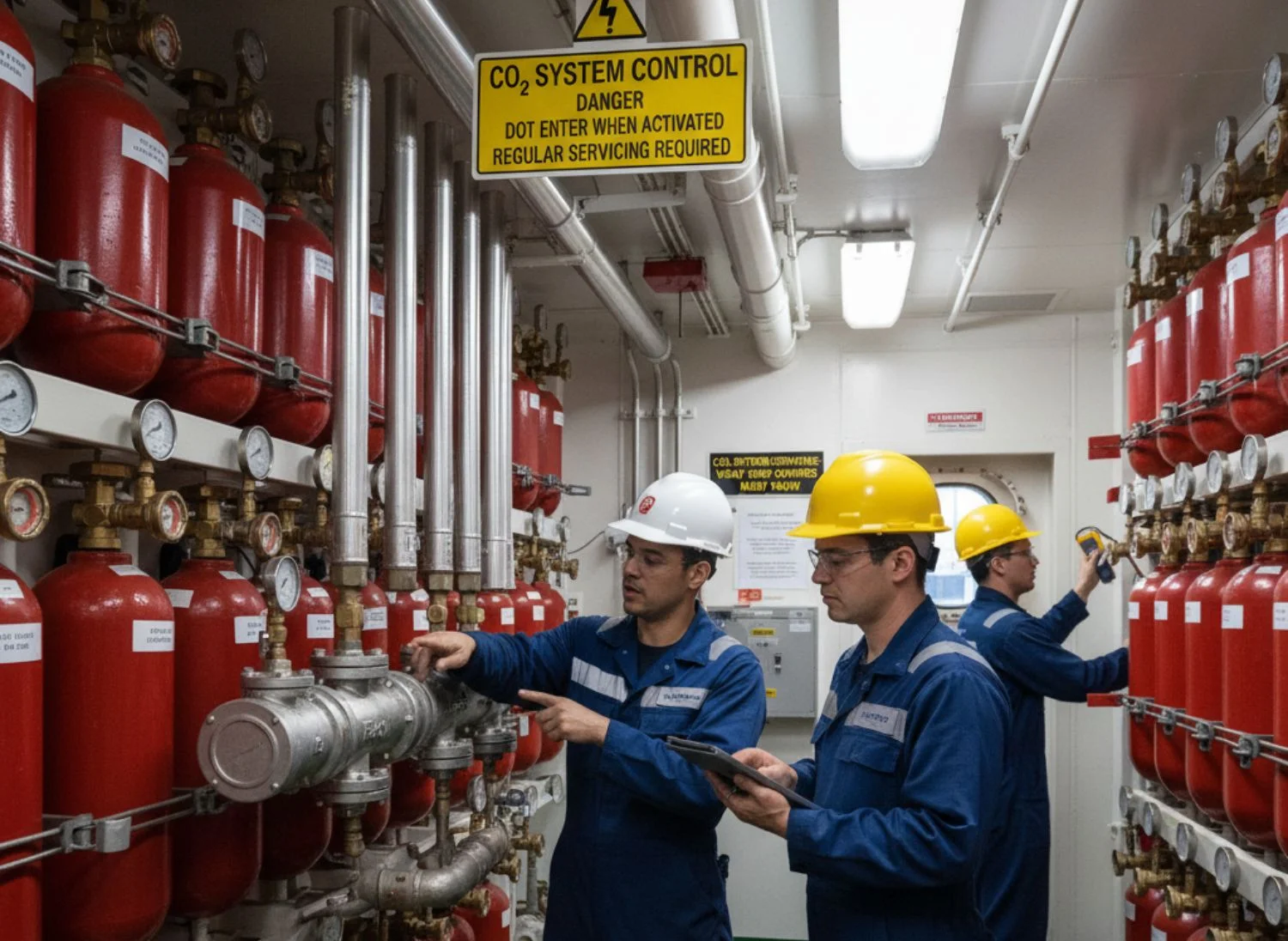
Fire-fighting appliances are among the most closely scrutinised systems aboard any SOLAS vessel, and an out-of-date extinguisher or an untested fixed installation is one of the most common grounds for a port-state control detention. For ships calling at India’s commercial ports on the Arabian Sea and the Bay of Bengal, from Mumbai and JNPT (Nhava Sheva) to Cochin, New Mangalore, Chennai, Visakhapatnam and Paradip, keeping FFA equipment serviced against SOLAS and the FSS Code is what allows a vessel to trade without delay.
Indian ports fall under the oversight of the Directorate General of Shipping (DG Shipping), with Mercantile Marine Department (MMD) surveyors and PSC officers examining safety equipment closely. A vessel that arrives with clean, current firefighting certificates and equipment matched to its Fire Control Plan gives inspectors little to question.
The equipment covered
Fire-fighting appliance servicing spans a vessel’s fixed and portable systems together. That includes fixed CO₂, foam, dry-powder and water-mist installations, sprinkler and deluge systems, fixed fire detection and alarm panels, portable and wheeled extinguishers, fire hoses, nozzles and the fire main, fireman’s outfits and emergency escape breathing devices (EEBDs), and self-contained breathing apparatus. ARCSHIP delivers fire-fighting appliance servicing across all of these to SOLAS Chapter II-2, the FSS Code and maker requirements.
- Fixed systems: weighing and internal examination of CO₂ banks, condition checks of foam concentrate and dry powder, pressure and flow testing of water-mist and deluge lines.
- Detection and alarm: function testing of smoke, heat and flame detectors, call points and the fire-alarm panel.
- Portable and wheeled extinguishers: annual inspection, refilling, re-charging and hydrostatic testing of bodies at rule-defined intervals.
- Breathing apparatus and SCBA: function checks, cylinder charging and hydrostatic testing of composite and steel cylinders.
- Hoses, nozzles and outfits: pressure testing of fire hoses and nozzles, and inspection of fireman’s outfits and EEBDs against expiry.
Typical servicing intervals
Firefighting equipment follows a layered schedule of crew checks and professional attendances. The broad pattern below is a guide only, since the exact dates for any ship come from its certificates and maker manuals.
- Monthly and quarterly: crew inspection of extinguishers, hoses, fixed-system pressure gauges and detection panels.
- Annual: thorough examination and function testing of fixed systems, detection and alarms; inspection and maintenance of portable and wheeled extinguishers; testing of fireman’s outfits and breathing apparatus.
- Every 2, 5 and 10 years: hydrostatic pressure testing of extinguisher bodies and of SCBA and CO₂ cylinders at maker- and rule-defined intervals, plus internal examination of fixed-system cylinders.
- As required: refilling and re-charging after use, and replacement of time-expired components.
Exact intervals depend on equipment type, class and flag rules, so each vessel’s FFA schedule should be confirmed against its Safety Equipment Certificate and maker documentation before a port call is planned.
A fixed CO₂ system that cannot be shown to have been correctly weighed and tested is treated as a serious deficiency at inspection, and PSC officers at Indian ports know exactly where to look.
Combining FFA with LSA in one attendance
Because fire-fighting and life-saving appliance servicing follow a similar regulatory rhythm, completing both during one Indian port call reduces attendances, paperwork and off-hire. A combined attendance at Mumbai, JNPT, Cochin or Visakhapatnam can cover function testing of fixed systems, servicing and re-charging of extinguishers, hydrotesting of cylinders, and the issue of consolidated test certificates in a single visit. Where instruments such as fixed gas detectors are involved, this can be scheduled alongside calibration services so the whole safety suite comes due together.
Staying port-state ready at Indian ports
The reliable way to avoid an FFA deficiency is to map every extinguisher, cylinder and fixed-system due-date against the vessel’s trading pattern and to schedule the professional attendance into a planned Indian call. That turns firefighting-equipment servicing into a routine, documented event rather than a detention risk. It also keeps stock of SOLAS-approved safety products ready for replacement of any time-expired item found during the attendance.