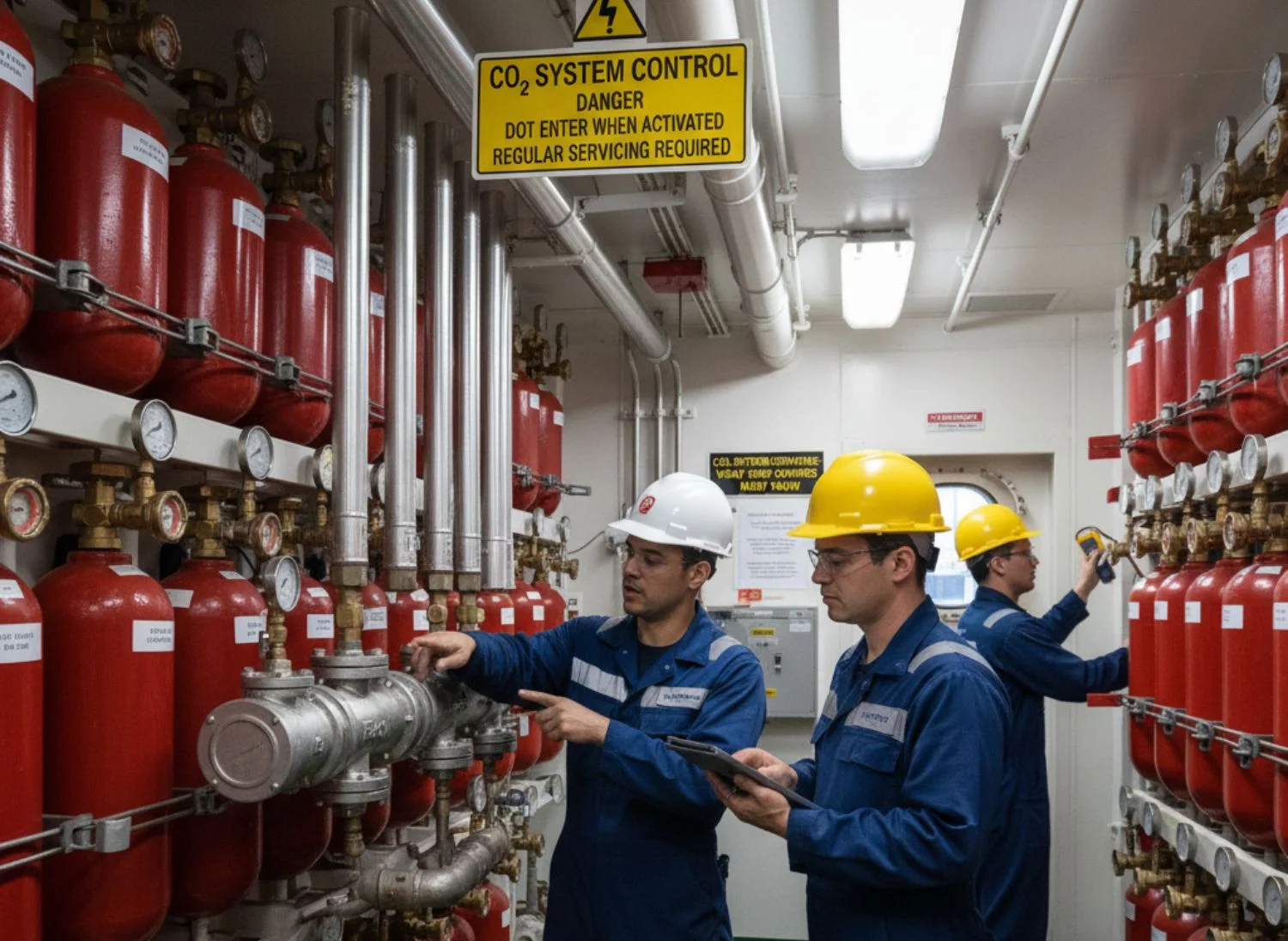
Fire-fighting readiness is one of the first things a port-state control officer looks at when a vessel berths in Oman, and expired servicing certificates are a common route to a detention. For shipowners and technical superintendents whose vessels call at Muscat, Sohar, Sur, Duqm, Salalah or Khasab, keeping every appliance in date is the difference between a clean inspection and a costly hold. This guide sets out the SOLAS framework, the equipment involved and the servicing intervals that matter.
The SOLAS and FSS Code framework
Fire safety on merchant vessels is governed by SOLAS Chapter II-2 and the International Code for Fire Safety Systems (the FSS Code), supported by IMO resolution guidance on maintenance and testing. Together they define what fire-fighting equipment a ship must carry, how it must be arranged and how often it must be inspected, tested and serviced by competent personnel. Certificates issued after each servicing are the documentary proof an inspector expects to see, and if the paper trail lapses the equipment is treated as unserviceable regardless of its physical condition. Because Oman is a member of the Indian Ocean MoU on Port State Control, vessels calling at its ports are inspected against a shared regional regime, and fire-fighting deficiencies rank among the most frequently recorded findings across the region.
What FFA servicing covers
A complete fire-fighting appliance servicing scope reaches well beyond the extinguishers on the accommodation bulkheads. It includes fixed CO2 and foam or water-mist systems, portable and wheeled extinguishers, fire hoses, nozzles and hydrants, the international shore connection, fireman's outfits with SCBA and breathing apparatus, emergency escape breathing devices (EEBDs), fire detection and alarm systems, the emergency fire pump, and fire dampers and quick-closing valves on tanks and ventilation. Each of these has its own maker instructions and its own inspection cadence, and each must be signed off against a certificate that the crew can produce on demand.
Servicing intervals at a glance
Intervals are layered: routine crew checks sit on top of formal annual and multi-year servicing by an approved technician. The following is a general picture, and the exact schedule for any vessel depends on the equipment type, the maker's instructions and the flag-state rules, so always confirm against the certificates on board.
- Monthly: crew checks of extinguisher pressure gauges, seals and locations, hydrant and hose readiness, breathing apparatus, and alarm function.
- Annually: professional inspection of portable and wheeled extinguishers, fire hoses and nozzles, detection and alarm systems, and the control and alarm arrangements of fixed systems; CO2 cylinders are typically weighed or level-checked annually.
- Two-yearly and five-yearly: more detailed fixed-system checks, foam concentrate analysis and functional testing per maker and flag rules.
- Periodic hydrostatic testing: extinguisher and CO2 cylinders are pressure-tested on a schedule that is roughly every five to ten years depending on cylinder type.
- Breathing apparatus: SCBA and EEBD cylinders undergo periodic hydrostatic testing and charge checks per the manufacturer's interval.
Fixed CO2 systems: the detail that gets missed
Fixed CO2 installations protecting engine rooms, cargo holds and pump rooms carry some of the most involved servicing requirements, and they are frequently where inspectors find lapses. A proper attendance covers weighing or ultrasonic level checks of every cylinder to confirm the charge, inspection of the discharge hoses and distribution pipework for corrosion and blockage, testing of the release station alarms and the time-delay unit that gives crew time to evacuate before flooding, and verification of the pneumatic or manual release lines. Small losses accumulate quietly, and a bank of cylinders that has drifted below its required charge will not deliver the design concentration when it is needed most.
An extinguisher with an expired certificate is treated as an empty bottle, no matter how full it is.
Staying inspection-ready in an Omani port call
ARCSHIP provides mobile attendance at the main Omani ports on the Gulf of Oman and Arabian Sea, all sitting outside the Strait of Hormuz: Muscat (Port Sultan Qaboos), the industrial deep-water ports of Sohar and Duqm, Sur, the major container transshipment hub of Salalah, and Khasab in Musandam. The practical advantage for operators is combining fire-fighting work with life-saving appliance servicing in a single port call, so liferafts, immersion suits and davits are certified alongside the fire equipment without deviation or extra off-hire. Where equipment needs replacing rather than recharging, ARCSHIP supplies SOLAS-approved safety products to close the gap before the vessel sails.
A typical ARCSHIP FFA attendance at an Omani port includes a full survey of portable and wheeled extinguishers, pressure testing and recharging as required, weighing and inspection of fixed CO2 banks with alarm and time-delay checks, hose and nozzle testing, servicing of SCBA and breathing apparatus, inspection of detection and alarm circuits, and issue of the servicing certificates the crew presents at inspection. The team works to the vessel's flag requirements and hands over a clear record of what was done and what falls due next.